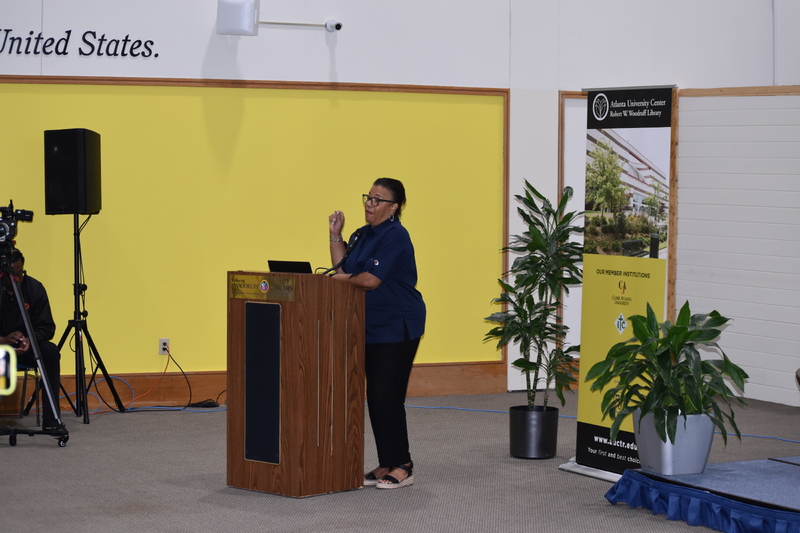
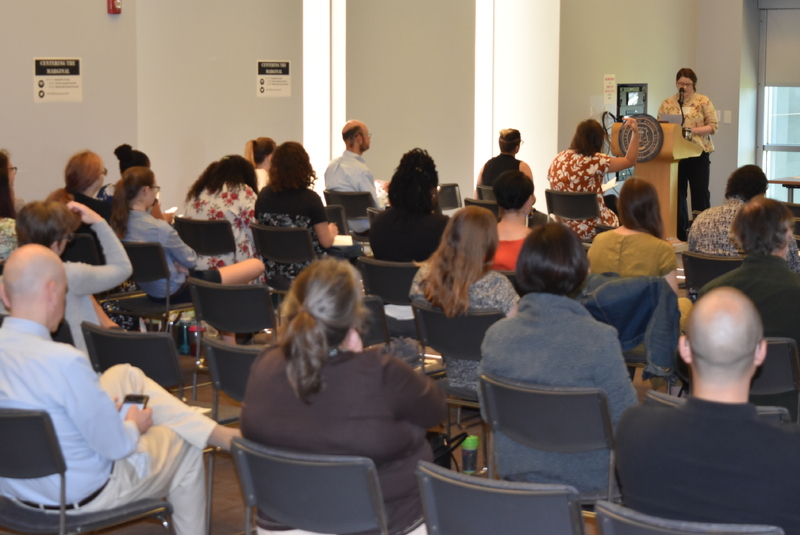
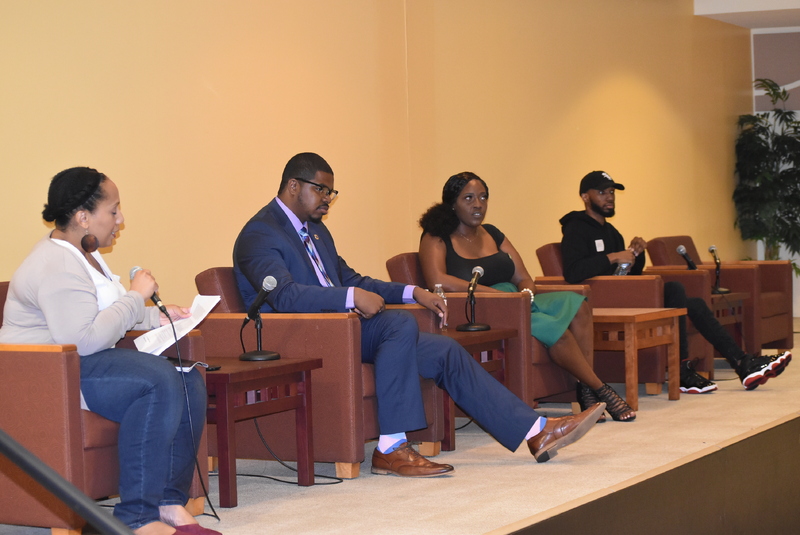
The dean of libraries at Robert Woodruff gives a brief introduction of the Project STAND residency and the partnership between Project STAND, AUC, and UMD
The dean of libraries at Robert Woodruff gives a brief introduction of the Project STAND residency and the partnership between Project STAND, AUC, and UMD
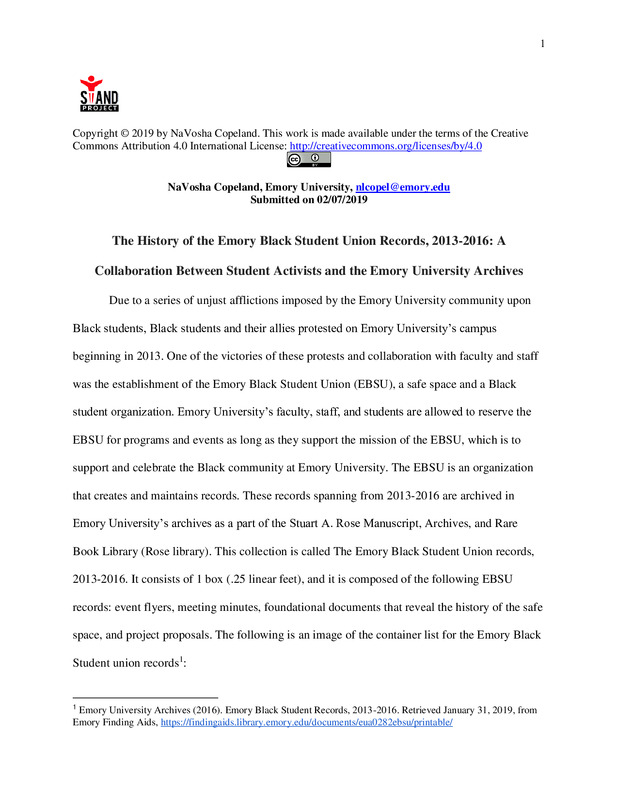
There is a long history of Black student protest at Emory University. Beginning in 1969, after the institution’s desegregation in 1962, Black students began to express their dissatisfaction with the institutional culture. They felt as though they were brought to the university to assimilate into White culture, rather than to elucidate the Black experience and see it represented within the fabric of the institution’s mainstream culture. They also formed the Black Student Alliance (BSA) and created a list of demands addressed to Emory’s administration. Some of these demands were met, and some were not. One of the demands that were met was the funding of the Department of Afro-American Studies. The legacy of Black student activism lived on at a Emory as evident by the Black student protests and demands spanning from the years of 2013-2015. During these years, Black students from different clubs and organizations joined together to speak out against injustice, demands for a safe space, and advocate for equity for all on Emory University’s campus. One of the results of this student activism was the establishment of the Emory Black Student Union (EBSU), which is a safe space for Black students on campus. The EBSU has a leadership team of a university staff advisor as well as paid student interns. The internship positions include the role of a Historian. In the EBSU’s third year of existence, during the academic year of 2015-2016, I served as the EBSU’s Historian. My responsibilities consisted of publicly displaying the history of Black student activism via multimedia presentations as well as archiving the EBSU’s manuscript and born digital records into Emory University's Stuart A. Rose Manuscript, Archives, and Rare Book Library (also called the Rose Library). I was a student, creator, custodian, historian, and archivist. I collaborated with John Bence, Emory University's University Archivist, who conducted outreach with the EBSU, to fulfill the archiving responsibilities. We archived the EBSU’s records, which consisted of the records and photographs of Emory University’s Black student organizations. During the subsequent summer after my EBSU internship, I completed a paid summer internship in Emory University's Rose Library and processed the EBSU records, which are officially called the Emory Black Student Union records, 2013-2016 (see the collection’s finding aid here: https://findingaids.library.emory.edu/documents/eua0282ebsu/?keywords=emory+black+student+union). Throughout my internship at the Rose Library, I processed the EBSU collection and rose awareness about it through a blog post that I wrote, which was published on the Rose Library’s website (see the blog post here: https://scholarblogs.emory.edu/marbl/2016/07/26/black-student-union-collection/). Furthermore, my summer internship in Emory's Rose Library served as a professional launching pad for me before I began my Master’s program in Library and Information Science at the iSchool at the University of Illinois at Urbana-Champaign. Throughout this experience, I developed an understanding of the ways in which the archivist as activist dynamic is accomplished. As a current Project Archivist at the Rose Library, I am continuing to develop my role as an archivist and an activist.
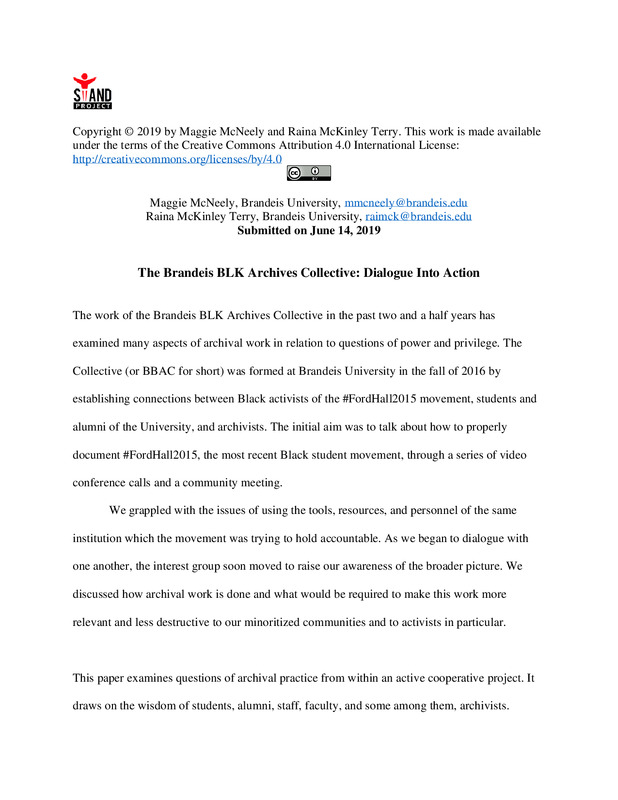
The work of the Brandeis BLK Archives Collective in the past two and a half years has examined many aspects of archival work in relation to questions of power and privilege. The Collective (or BBAC for short) was formed at Brandeis University in the fall of 2016 by establishing connections between Black activists of the #FordHall2015 movement, students and alumni of the University, and archivists. The initial aim was to talk about how to properly document #FordHall2015, the most recent Black student movement, through a series of video conference calls and a community meeting.
We grappled with the issues of using the tools, resources, and personnel of the same institution which the movement was trying to hold accountable. As we began to dialogue with one another, the interest group soon moved to raise our awareness of the broader picture. We discussed how archival work is done and what would be required to make this work more relevant and less destructive to our minoritized communities and to activists in particular.
This paper examines questions of archival practice from within an active cooperative project. It draws on the wisdom of students, alumni, staff, faculty, and some among them, archivists.
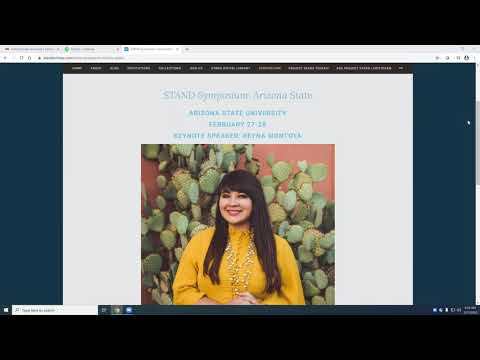
Keynote Speaker: Reyna Montoya, Founder and CEO of Aliento
Panel: Emerging Voices of Student Activism in Indigenous Communities
Traditionally, student voices in the indigenous community have not been
well represented in archival collections. How can we build relationships,
increase trust and understanding, and perhaps empower indigenous
students to capture their own histories? The focus of this panel will be to
highlight these issues and hear first-hand from student activists in the
ASU indigenous community.
Jeston Morris, Arizona State University
● ASU-Turning Points Magazine Team:
○ Taylor Notah, Arizona State University
○ Danielle Lucero, Arizona State University
○ Ravenna Curley, Arizona State University
○ Brittany Gene, Arizona State University
○ Savannah Jacobs, Arizona State University
● Alex Soto (moderator), Arizona State University
Performance-based presentation (Liaizon/AKA Alex Soto and a DJ)
Liaizon of Shining Soul will perform a hip-hop set that will highlight
Indigenous perspectives of social justice activism and advocacy here in
Arizona. This performance will speak to common themes felt within
marginalized communities and highlight the struggles faced by these
groups and how, through hip-hop, the voice of the marginalized can be
heard.
Documenting the Now ( DocNow ) Dialogue and activity: Learning from
Communities (Jessica C. Neal and Micha Brodnax )
Participants will identify personal and collective documentation creation
habits, utilization, dissemination, and stewardship practices. The primary
objective of the workshop is to facilitate a dialogue on record creation as
a way Pop of evidencing and memorializing student activism—protests,
experiences, social justice initiatives, and dissent.
Dr. Dara Walker is an Assistant Professor of African American Studies, History, and Women’s, Gender, and Sexuality Studies at The Pennsylvania State University. She earned her PhD in History from Rutgers University in 2018. Dr. Walker’s research and teaching interests include African American history, urban history, History of Education, and the history of childhood and youth. She is currently writing her first book, High School Rebels: Black Power, Education, and Youth Politics in the Motor City, 1966-1973, which examines the role of Black high school student organizing and politics in the development of Detroit’s Black Power movement. She has also authored “Moving Beyond the ‘Dark Africa’ Narrative: Black Girls, Black Power, and the Battle for a Culturally Relevant Curriculum” in The Global History of Black Girlhood by Corinne Field and LaKisha Simmons.
Prior to returning to Texas After Violence in 2016, where he previously served as project coordinator and associate director, Gabriel worked as a capital post-conviction investigator for the Office of Capital and Forensic Writs, criminal justice research associate at the Brennan Center for Justice at New York University School of Law, and project coordinator of the Guantánamo Bay Oral History Project at the Columbia Center for Oral History Research. Gabriel is the recipient of the 2018 Pushcart Prize for nonfiction. His writings have appeared in Texas Monthly, Texas Observer, Oxford American, Scalawag, Cultural Dynamics: Insurgent Scholarship on Culture, Politics, and Power, and Kula: Knowledge Creation, Dissemination, and Preservation Studies. Gabriel has also served as a consultant for the Ford Foundation’s Reclaiming the Border Narrative initiative, the NAACP Legal Defense Fund Oral History Project, and the UCLA Archiving the Age of Mass Incarceration project. Gabriel is also currently serving as a Fellowship Mentor for Fanny Garcia’s Separated, a National Endowment for the Humanities supported project documenting the lived experiences of parents separated from their children at the U.S./Mexico border under the “zero tolerance” policy in 2018.
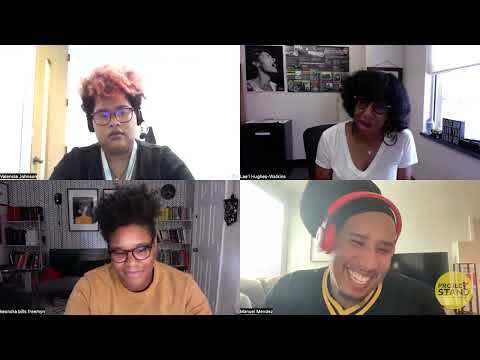
Project STAND pod hosts Lae'l Hughes-Watkins and keondra bills freemyn interview, Trinice McNally. Trinice Ìyá Fábùnmí [ McNally (she/her) is a Black Queer Feminist Migrant & Survivor and nationally recognized transformative leader, student affairs professional, organizer, and creative committed to the liberation of oppressed people. She is passionate about developing strategies, initiatives, and curating spaces for historically marginalized populations to transform & thrive through programmatic, advocacy & political education efforts. Trinice was born in London, England, by way of Jamaica as a grandchild of the Windrush generation. She is an Ifá [ practitioner in the Yoruba Tradition. She serves as Iyálòdé with her partner Olùwó Bàbá Ifálòwó Ajośe Adéòlá, where they preside over Ijó Ifà Ogùndá Másà, an Esín Ibìlé Oriśa Temple (Traditional Ifá/Oriśa worship)based in Hyattsville, MD. Trinice currently serves as the founding director of the Center for Diversity, Inclusion & Multicultural Affairs at the University of the District of Columbia (UDC), founding organizer of the Envisioning Safety On Our Campuses Now Project (ESOC NOW)
Manuel Mendez, Chair for the DC AfroLatino Caucus, is originally from the Dominican Republic and moved to Washington, D.C. at the age of nine. After graduating from Bell Multicultural High School, Mr. Mendez received his bachelor’s degree in African Studies and Communication at Antioch College in Yellow Springs, Ohio. Fortunate to have a host of mentors in his adolescence, Mr. Mendez’s passion for supporting positive youth development and the issues that plague the people of the African Diaspora are ever apparent themes in his pursuit for affecting progressive change in his community. As a constant staple in the Columbia Heights neighborhood, Mr. Mendez’s dedicated support has allowed him to forge long-term meaningful relationships with members of the community. Currently as the chair of the DC AfroLatino Caucus, Mr. Mendez’s goal is to unite “black and brown” people of the Washington metropolitan area.
In this episode of Project STAND's podcast, "A Blueprint," we interview Atlanta native and student activist Zoe Bambara Daniels. She discusses leading a downtown ATL protest in 2020 in the aftermath of the killings of Breonna Taylor, George Floyd, and Ahmaud Arbery. Zoe also shares the importance of self-preservation on the road to liberation.
On this episode of Project STAND's podcast, "A Blueprint," we share updates about receiving a grant from The Mellon Foundation, our plans for the three-year grant, welcome our inaugural Project STAND coordinator, and some baby news!
Wanda Hernandez is a doctoral student in the Department of American Studies at the University of Maryland. Her research interest revolves around the formation of race and ethnic identity among U.S. Central Americans through material and visual culture, space and place, and performances of the everyday. In addition to academia, Wanda is an independent curator and cultural organizer. In 2017, she curated Nuestras Historias: Latinos in Richmond, the first bilingual exhibition to explore Latina/o heritage in Virginia. Currently, she is a part of a curatorial collective named Creating Casa, which organizes art exhibitions and public programs that question Latinx identity and placemaking in the Washington metropolitan area. Their next show, entitled Siempre Aquí, will open in April 2021 and will map the memories of DMV Latinxs through personal photographs.
Project STAND pod hosts Lae'l Hughes-Watkins and Valencia Johnson interview Alex Soto. Alex is a member of the Tohono O’odham Nation and a 2020 graduate student earning a Master of Arts in Library and Information Science from the University of Arizona. He is a Knowledge River, ALA Spectrum, and ARL Kaleidoscope scholar. Alex’s journey to librarianship comes after years of success as a touring hip-hop musician/educator and activist. As a graduate student, Alex has realized the importance of culturally relevant information literacy within tribal communities and the role of reparative archives in strengthening Indigenous sovereignty. Alex manages the Labriola National American Indian Data Center at Arizona State University. In this episode, Alex discusses how his life as a member of Tohono O’odham Nation and as a hip-hop artist, educator and activist influence his work LIS.
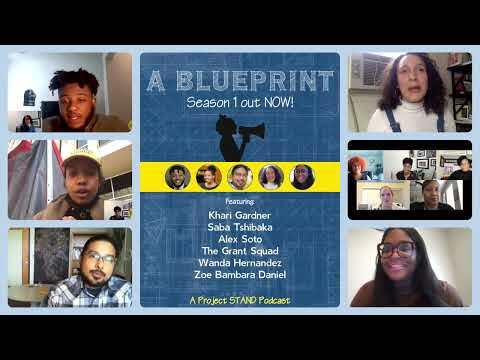
This is a trailer of the first entire season of Project STAND's podcast, A Blueprint, is out! Interviews include the founder of Black Lives at the University of Kentucky, a member of the Tohono O'odham Nation, a student activist from Brown University, and the granddaughter of Toni Cade Bambara, a coalition builder from the University of Maryland, and a memory worker breaking new barriers!
Saba Tshibaka, President of Black Terps at the University of Maryland, has an honest conversation about the importance of "showing up" and what it means to support a movement and those on the front lines. During this interview, she is at Tent City occupation at the Department of Education. Saba and other activists are calling attention to more equitable education for Black students. She talks about walking in the Women's March in Washington D.C and receiving support from the SunRise Movement at George Washington University and mentorship from DeAndre Gates, an Atlanta Community Organizer.